
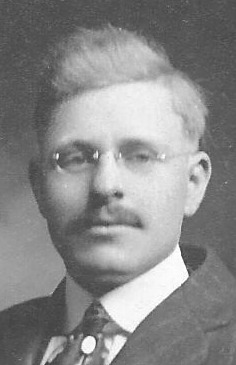

Walter D. Farabaugh (1893-1918)


“I don’t know if they found out!” This utterance marks the return of our most disenfranchised relative, Cecil Farabaugh. His much older half-brother Walter was reportedly gassed in WWI. When Walter was exhumed from a temporary grave in France (marked by the cross shown here) and brought to Carrolltown for reinterment (the headstone, also shown), there was an inspection of the remains to see if it was really him. It was conducted by Walter’s father Joseph, and by Dr. Charles Farabaugh, brother to Walter. The results were not shared with 12-year-old Cecil, hence the exclamation.
Walter belonged to the 16th Infantry Regiment, Company H. He reported to Camp Lee, Va.,, and then was shipped out on the transport vessel “Czaritza” from Newport News on July 18, 1918, as part of the fourth provisional company draft, having already achieved the rank of Corporal. It arrived at Brest, France and the replacement unit joined the First Division on August 5. Walter participated in the San Michel offensive in September, and then the Meuse-Argonne Campaign, as part of a “defensive sector.“ The first phase that begin on September 26 included the US artillery firing some 800 shells of mustard gas and phosgene at the German positions, with infantry successfully advancing the next day. The offense was called off on September 30 or October 1 when the maneuvers stalled, as the Germans countered with their own artillery that included mustard gas shells. The American soldiers were equipped with M-2 masks and/or small box respirators. If Walter was exposed to mustard gas on October 3, it was the day before the offensive’s second phase. On October 4, when Walter died a at the Julvecourt Hospital, the 16th was engaged in the successful liberation of Fleville village in the Argonne. It is unclear how Walter could have been exposed on October 3, when there was no engagement. Nonetheless, many casualties resulted due to the delays in detection of the mostly odorless gas that could linger for days on the battlegrounds.
The Daily Tribune, now the Tribune-Democrat in Johnstown, reported on 14 Jul 1921 that Walter’s remains arrived in Hoboken, N.J. Cecil recalled that when the casket came to Carrolltown, a guard was assigned to it at all times. Yet, there was enough family doubt that a private viewing of the remains was requested. Walter must have suffered a horrible, suffocating death. Mustard gas also scalded exposed skin and, in a sense, the short duration of his suffering was merciful. Other soldiers agonized for weeks following exposure to the deadly gas, deployed by both sides of the conflict.