There were three Farabaugh brothers who served in the Civil War. The oldest, Charles Farabaugh (1834-1909), is buried in Nicktown, Pa., and had a significant enlistment, from October of 1863 to August of 1864. The second was Barney Farabaugh (1835-1862). He was in reserve for the Battle of Dranesville and succumbed to typhoid fever while marching through Alexandria, Va. He is buried at the military cemetery there.
The third brother was Anselm Farabaugh (1841-1891). He is in the 1860 Census as a 17-year-old laborer living in Ebensburg, Pa. He was “mustered in” as they say, in April of 1861, but left service in July of the same year. He was a Private in Company G of the 10th Regiment of Pa. Volunteers and did not see significant action. He then disappeared from the known family history, except for a tantalizing clue left by Fr. Modestus Wirtner, OSB (1861-1948). He compiled a chart of the various Farabaugh families in 1927-8, and here is what he listed for this family:

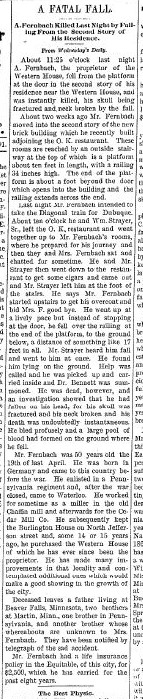
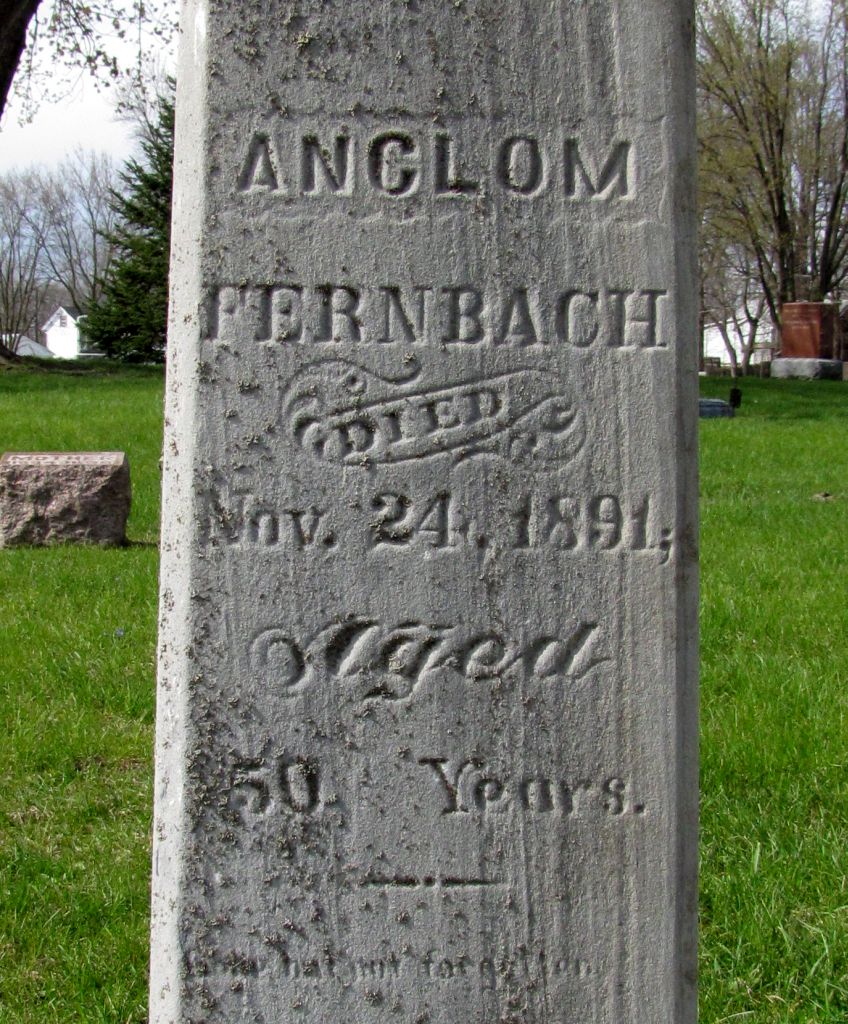
Anselm “died at a party, Waterloo, Iowa.” How? When? Why? Fr. Modestus gives no details. There were no other clues. In 2014 I fired off an email to the Cedar Falls Historical Society. Ms. Julie Huffman-Klinkowitz there had the answers. Anselm died from a fall in 1890 at the age of 50. The tombstone and article in Waterloo are reproduced below.
However, this article says nothing of his colorful past. Over the years the local newspapers reported a host of wild exploits that featured Anselm and, if you look closely at this tombstone you will find the small inscription, “Gone but not forgotten.” Now we bring the tombstone’s prophecy to life with newspaper accounts that detail his adventures and misadventures. Anselm was a wild and crazy guy.
After his brief service in the Civil War, Anselm ends up in Waterloo, Iowa, where he marries a German girl named Sybil Fisher in 1865. After working in the local flour mill, he somehow acquired the means to buy local land, including the Western House Hotel on 4th Street. From this base of operations, Anselm left a legacy of altercations, alcohol-related offenses, vigilante justice, an injury case that went to the Iowa Supreme Court, a 1882 wife swap, a funny wheelbarrow bet over the 1888 presidential election, and a U.S. Marshal investigation that was cut short by his fatal fall in 1891. A complete (somewhat tedious) chronology is here. But the entertaining highlights are as follows:
1. Altercations. Anselm’s recorded career of confrontations begins in 1875, when he cracks the skull of a drunken sailor who was harassing the local grocer. In 1880, Anselm was brought to court for horsewhipping his wife Sybil, leaving a severe gash on her forehead. He was put in jail 8 days not for the offense, but for refusing to pay the $25 fine. Not all of the fights were started by Anselm. He was once robbed of $40 at gunpoint, and when a matter with Jacob Kauth of Hudson was “arbitrated by the fists,” the mayor fined Kauth and not Anselm.
2. Alcohol-related Offenses. Anselm’s liquor license was revoked in in 1877. In the years that followed he was arrested several times for selling. In 1884, Anselm paraded around town with a large bottle in one hand and a revolver in the other, demanding all to drink with him. The charges are dropped when his attorney somehow convinced the court he was only pretending to be drunk and that the bottle only had sweet water and vinegar. A serious federal indictment for his habitual sales was pending in Dubuque at the time he had his fatal fall in 1891.
3. Vigilante Justice. In 1877, Anselm helps a local marshal by chasing down a horse thief, tying his feet under the stolen equine and walking him down Commercial Street in triumph. In the years that followed, Anselm settled disputes with his (allegedly) non-paying boarders by regularly chasing them down and seizing their possessions, sometimes with the aid of law enforcement.
4. Wife Swap. Read this carefully and follow along. A man named Jacob Fernbach from New York was stranded in Waterloo and, being struck by Anselm’s same last name, took up residence at the Western House with his wife Maggie. Anselm ditches his wife Sybil for Maggie, an incident that involved a gun toting confrontation with Sybil’s relative Nicholas. Anselm and Maggie marry. Sybil immediately marries a railroad conductor named Edward Chapman. Jacob moves on — all within a few weeks in 1882.
5. Wheelbarrow Bet. Anselm loses a bet when Benjamin Harrison defeats Grover Cleveland in the 1888 presidential election. Anselm was “gaily decorated for the occasion, and with a good-sized fish-horn frightened away all obstructions” as he started out to carry Jake Hoffman by wheelbarrow to Cedar Falls, about 8 miles away. Reading this triggered my memory that such a bet was depicted in this Disney movie.
6. Iowa Supreme Court Case. In 1885, Anselm incurs serious injuries when his horse and carriage run into a street hole in Waterloo. Anselm’s lawsuit (which probably involved a legal issue over governmental immunity) fails but it is reported that appeals took the case to the state Supreme Court and that the case evidently ended in Anselm’s favor. Nonetheless, the town counsel made cost claims against Anselm’s estate following his death in 1891.
7. Harassment of Gospel Singers. A visiting performance by the Colored Georgia Jubilee Singers was considered “too rocky.” The second performance was cancelled when Anselm and another boarding house owner decided to immediately demand rent from them, knowing that income from the second performance was needed to meet the rooming debts. Anselm confiscates the manager’s trunk and the performers’ costumes.
8. The Committee of Unclear Purpose. In 1888, Anselm helps start the 6 member Waterloo Self-Constituted Improvement Company, and becomes its President. It is formed “to decorate and beautify whatever needed.” No subsequent action of the committee is reported.
When Anselm fell off a stair landing and cracked his skull at the age of 50, he did not leave behind any known natural offspring (he had an adopted son however). His Farabaugh relatives in Pennsylvania probably knew nothing of his adventures. But one of them, Fr. Modestus Wirtner, at least noted his location in Waterloo, which enabled me to eventually uncover this colorful if disreputable character. Anselm is truly gone but not forgotten, all thanks to the efforts of Ms. Julie Huffman-Klinkowitz of the Cedar Falls Historical Society!